 Interface Converters
 Power & Data Isolators
 GSM Devices
 Ethernet Converters
 Exclusive Innovations
 Data Loggers
 Controller Boards
 RFID Readers


Modbus has been the default industrial protocol for decades for a simple reason: it’s simple. But “Modbus” isn’t one thing — Modbus RTU runs over serial (RS485/RS232), while Modbus TCP runs over Ethernet. When you’re connecting an older RTU-based instrument to a newer Ethernet-based SCADA or PLC network, you need a protocol converter to bridge the two.
Modbus RTU vs Modbus TCP: the actual difference
Modbus RTU
A serial protocol over RS485 or RS232. Devices share a physical bus, addressed by a device ID (1–247), and only one device transmits at a time. It’s simple, cheap to wire, and still the default on most sensors, meters, and single-loop controllers.
Modbus TCP
The same request/response structure as RTU, but wrapped in a TCP/IP packet and sent over Ethernet. It supports simultaneous connections, works over your existing network infrastructure, and is what most modern SCADA platforms and cloud gateways expect to talk to.
The message structure between the two is close enough that a converter’s job is mostly protocol translation and framing — but getting addressing, timeouts, and multi-drop handling right is where cheap converters fall short.
Why you need a converter instead of “just using Ethernet”
Replacing every RTU-based instrument in an existing installation with an Ethernet-native one is rarely realistic — the instruments work fine, the wiring is already run, and swapping hardware for a protocol change is expensive. A protocol converter (Modbus RTU-to-TCP gateway) lets you keep the existing serial devices and simply bridge them onto the Ethernet network your newer systems use.
What to look for in a converter
- Multiple serial ports if you’re bridging more than one RTU bus — a multiport converter avoids needing a separate gateway per bus
- Correct addressing/mapping support — the converter needs to map RTU device IDs to TCP requests cleanly, without you hand-managing a lookup table
- Isolation on the serial side, for the same ground-fault reasons covered in our isolation guide — Ethernet-connected equipment is often on a completely different power zone than the field instruments
- DIN-rail mounting, since these usually live inside an existing panel next to the equipment they’re bridging
A common real-world case
A facility has RS485 Modbus RTU energy meters wired through a plant, and a new SCADA system that only speaks Modbus TCP over the plant Ethernet backbone. Rather than rewiring every meter, a multiport protocol converter sits at the panel, polls the RTU meters on the serial side, and re-exposes their registers over TCP — no changes to the meters or their wiring.
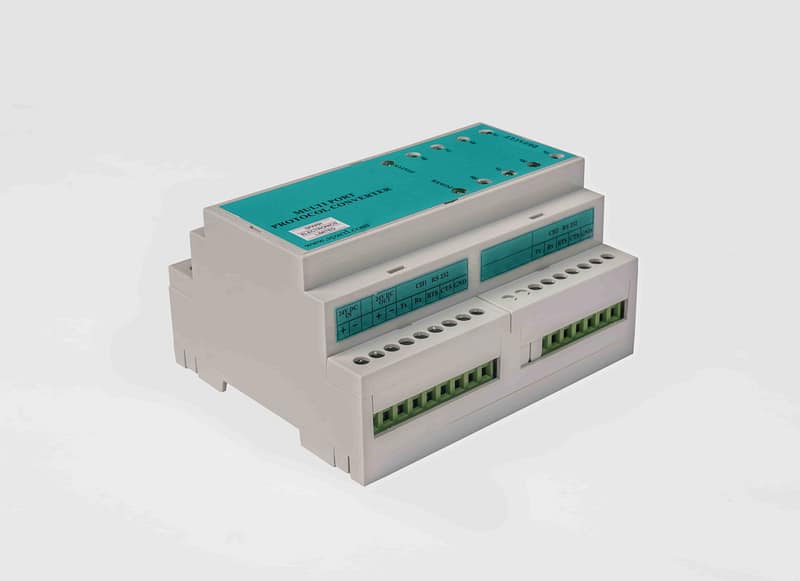
Sparr’s Multiport Protocol Converter handles exactly this kind of RS485-to-RS232/TCP bridging with proper address mapping, and sits alongside our RS232/RS485 converters in the Converters category if your bridge is simpler — serial-to-serial rather than serial-to-Ethernet.
Tell us how many devices and which protocols you’re bridging and we’ll recommend the right converter rather than the most expensive one.